
What Flow Actually Is (Neurologically)
Flow state was first described by psychologist Mihaly Csikszentmihalyi in the 1970s. He identified it as a state of complete absorption where self-consciousness disappears, time distorts, and performance peaks. But the “how” of flow — the mechanism — wasn’t understood until neuroscience caught up decades later. Here’s what happens in your brain during flow: **Theta wave dominance.** Alert consciousness operates in beta (13-30 Hz). Relaxed awareness operates in alpha (8-13 Hz). But flow — the sweet spot where creativity, focus, and effortless action converge — operates primarily in theta (4-8 Hz). This is the same frequency band your brain enters just before sleep and during deep meditation. It’s a state of “relaxed alertness” — calm enough for the prefrontal critic to quiet down, alert enough to execute at peak capacity. **Transient hypofrontality.** During flow, the prefrontal cortex — the seat of your inner critic, your self-monitoring, your “am I doing this right?” narrator — temporarily reduces its activity. This is called transient hypofrontality, and it’s the neurological reason why flow feels effortless. You’re not fighting yourself. The part of you that judges, second-guesses, and hesitates is offline. **Neurochemical cascade.** Flow triggers a cocktail of performance-enhancing neurochemistry: dopamine (focus + reward), norepinephrine (alertness + energy), anandamide (creative pattern recognition), and endorphins (pleasure + pain suppression). Your brain literally rewards you for being in flow — which is why it feels so good and why you want to return to it.Why Most Productivity Advice Misses the Mark
The productivity industry sells you willpower tools: Pomodoro timers, to-do list methodologies, “eat the frog” discipline strategies. These all operate in the prefrontal cortex — the very part of your brain that flow requires you to quiet. You cannot force flow through effort. The harder you try to focus, the more your prefrontal cortex activates, and the further you get from the theta-dominant state you need. It’s like trying to fall asleep by yelling at yourself to relax. The people who reach flow reliably don’t try harder. They enter the right brainwave state first, and the focus follows.How Clinical Hypnosis Trains the Flow Response
A well-structured hypnotic induction does exactly one thing: it guides the brain from beta into alpha, and then from alpha into theta. After 15-20 minutes of guided hypnosis with theta-range binaural beats, your brain has been training in theta for roughly the length of a deep work session. The more you do this, the easier it becomes for your brain to access that state on its own — without the audio, without the guidance, without the warm-up. This is not meditation. Meditation is wonderful, but it trains sustained attention on a single point — a different skill. Hypnosis trains state transition: the ability to move from distracted beta into focused theta quickly and reliably. Neuroscientists call this neuroplasticity — the brain’s ability to reorganize itself through repeated experience. Each session is a learning trial. The path into theta grows wider and smoother every time you walk it.The Caffeine Problem No One Talks About
Caffeine blocks adenosine receptors — that’s how it keeps you alert. But adenosine is also involved in the natural transition from beta to alpha. When you flood your system with caffeine, you’re not just staying awake — you’re making it harder for your brain to descend into the relaxation-focus frequencies where deep work actually happens. Paradox: the more coffee you drink to focus, the more you lock yourself into a beta state that prevents flow. This is why some of the most productive people I know have switched their morning routine from “coffee + email” to “theta audio + calm entry into the first task.” They report better focus, longer deep work sessions, and — counterintuitively — more energy across the entire day.A Morning Routine That Replaces Stimulants
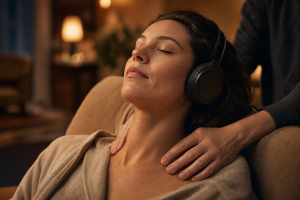
Here’s what I recommend to clients who want to build flow as a skill: 1. Wake up. Do not reach for your phone. The first 20 minutes of your day set the dominant brainwave state you’ll operate from. 2. Put on headphones. Use a guided theta hypnosis track with binaural or isochronic entrainment. 3. Press play. Close your eyes. Let 20 minutes pass. Do not “try” to focus — just listen and let the induction do its work. 4. Open your eyes and start your first task immediately. The theta momentum will carry you into the first 60-90 minutes of deep work with minimal resistance. That’s it. No caffeine. No phone. No willpower battles. Just a deliberate transition into the state where focus lives naturally.What the Research Shows
– A 2020 EEG study in *Scientific Reports* demonstrated that theta-range binaural beat stimulation significantly increased theta power in the frontal cortex — exactly the region associated with flow and creative problem-solving. – Research on hypnosis and cognitive performance has shown that a single 20-minute hypnotic induction before a cognitive task improves sustained attention, working memory, and creative problem-solving compared to controls. – The U.S. military has invested in flow-state research for decades because a soldier or analyst in flow processes information faster, makes better decisions, and sustains performance longer than someone operating in beta. This is not mystical. It’s measurable, trainable, and available to anyone who is willing to stop trying so hard and start using the right tool.One Session. Every Morning.
was designed for exactly this: 20 minutes of clinical hypnosis with theta-range binaural beats, structured for rapid state transition. Use it as your morning anchor — the first 20 minutes of your day, before email, before coffee, before the world starts demanding things. Headphones on. Press play. Then start your real work.
~ 4 min read · More articles →