Hypnosis for Creativity: Unblocking the Flow of Ideas
Three hours into the evening, the cursor blinks on the same sentence. The ideas that arrived easily in the shower — the ones that made you reach for a notebook — are gone, and the harder you lean into the blank page, the emptier it gets. If this is your normal, you are not short on talent, material, or effort. You are stuck in the wrong state: the state where the inner critic runs the room.
Creative work has a peculiar trap. It is produced by the subconscious and judged by the conscious mind, and the moment the judge takes the stage, the producer refuses to work. That is why no amount of pushing, planning, or deadline pressure fixes a creative block — and why hypnosis for creativity keeps gaining attention: it works on the producer instead of the judge. By guiding you into absorbed attention and layering suggestion into that state, it lowers the critical filter, strengthens the associative machinery underneath it, and trains the brain to generate before you sit down — not after you’ve stared at the page long enough.
Below: how hypnosis actually changes creative performance and the research behind it, why creative block is a subconscious problem no productivity app can fix, and a 21-day protocol for putting creative flow on schedule instead of waiting for it.
How Hypnosis for Creativity Actually Works
Hypnosis is not a magic wand and not a stage trick. It is a deliberate shift into absorbed attention — the same narrow, single-point focus that a hypnotist calls trance — combined with suggestion delivered while the critical mind is off duty. In that state, three things happen that matter directly to creative work.
It lowers the defensive filter. Creative output is filtered before it is voiced. Half-formed ideas are rejected by the critic before they ever reach the page, and the filter runs on defensiveness: the fear of producing something bad in front of an audience of one. The classic creativity-and-hypnosis research was built on exactly this. In a 1967 experiment, participants given hypnosis with suggestions of reduced defensiveness scored higher on creativity test performance than controls (Bowers, Journal of Personality, 1967). Quiet the defensive filter, and more candidates survive to be shaped.
It trains absorbed attention — the backbone of flow. The trance state and the flow state share a signature: narrowed attention, reduced self-monitoring, altered time perception, effortful action that feels effortless. A 1985 study in the International Journal of Clinical and Experimental Hypnosis tested this directly and found that hypnosis had a differentially enhancing effect on verbal and non-verbal creativity test performance in hypnotizable participants (Effects of Hypnosis on Verbal and Non-Verbal Creativity, 1985). Practice entering absorbed attention on command, and you are practicing the exact state in which ideas actually get made.
It installs creative defaults below the surface. A suggestion delivered in absorbed attention is not the same as a pep talk. The subconscious receives it, rehearses it, and files it as an operating instruction: ideas arrive easily, often, and without force. Repeated nightly, the instruction becomes the baseline. Flow shows up because the default changed — not because the deadline got loud enough.
Notice the common thread. None of this makes you more intelligent or more talented. It changes the state you create from and the filter you create through.
The Science of the Creative Brain
Modern imaging research has given the old observations a neural home. In a 2018 study in PNAS, researchers found that individual creative ability could be predicted from patterns of brain-wide functional connectivity — and that the hallmark of highly creative brains was strong coupling between the default mode network, the system active during mind-wandering and spontaneous association, and the executive control networks (Beaty et al., PNAS, 2018). Creativity, in other words, is not one region working harder. It is flexible switching: generating loosely, then shaping precisely — and the switching performs best in a calm, absorbed, low-alarm brain.
That is precisely the state hypnosis produces. The down-shifted, single-point attention in which the default mode network runs freely is the same state in which loosely associated ideas surface and connect. Block is not a shortage of associations; it is a shortage of access to them.
The classic findings fit alongside this. Kenneth Bowers’ 1967 study demonstrated that creativity test performance rose when hypnosis was paired with suggestions of reduced defensiveness (Journal of Personality, 1967) — the state-level removal of the critic. And the 1985 IJCEH experiment found differential gains in verbal and non-verbal creativity in hypnotizable subjects under hypnosis relative to control conditions. Two different designs, two different eras, same direction: hypnosis shifts the conditions under which creative cognition improves.
One honest limitation. These experiments measure laboratory creativity — alternative-uses tasks, verbal fluency, drawing tests — not the completion of a novel or a campaign, though many working writers, musicians, and designers report real-world gains. Hypnotizability also varies: people higher in absorption show stronger effects. The practical claim is narrower and true: hypnosis reliably produces the absorbed, low-filter state in which creative cognition is known to improve, and repetition of that state raises your creative baseline.
Why Creative Block Is a Subconscious Problem
Block is not a motivation deficit. It is a channel problem. The conscious channel evaluates, edits, and plans; it is slow, serial, and unforgiving. The subconscious channel generates, associates, and connects; it is fast, parallel, and silent. Creative work happens when the silent channel feeds the loud one — but the loud one drowns the silent one the moment you demand output.
That is why the standard toolkit fails. Willpower recruits the critic and tells it to try harder — pushing on the exact system that is strangling the work. Productivity apps add structure to the conscious channel, which is the wrong channel. Caffeine and tight deadlines add arousal, and arousal is the enemy of the loose associative state. Every one of these pushes on the wrong side of the glass: demanding creative output from a channel that only delivers when it is not being watched.
Hypnosis pushes on the right side. Absorbed attention occupies the critical channel — it has a narrow something to follow, so it stops surveilling — and the generative machinery underneath keeps running unobserved, the way it does in the shower, on a walk, in the quiet first minutes of a session. Then suggestion tells that running machinery what to do with itself.
Repetition is the currency. Each session teaches the pairing — headphones on, attention absorbed → ideas arrive — until the pairing becomes the default. That is why a single “try to be creative” session at 2 a.m. under deadline does little, and why a consistent nightly ritual does a lot.
The 21-Day Creative Unblock Protocol
The goal here is not a personality transplant. It is a lower filter and a trained association reflex. Twenty-one days, deliberately boring, deliberately consistent.
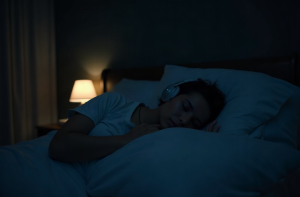
Step 1: Train absorbed attention daily — one structured hypnosis audio, at a fixed time. Choose a single guided session and commit to it for the full three weeks. A fixed-point session like Gaze — The Fixed Point is built as one arc: it anchors attention on a single point, carries you deeper, and delivers its suggestions at the depth where they land. Run it in the twenty minutes before your main creative block — or at lights-out if you create in the mornings. Over-ear headphones, comfortable volume, eyes closed. Consistency is the intervention: you are teaching your nervous system to find the creative state on command.
Step 2: Prime every work session in five minutes. Before each creative block, settle in. Three long exhales. Then one internal phrase, repeated twice: “ideas arrive easily and often.” This is not affirmation-bingo; it is a cue, and cues work by repetition. Use the same words every single day.
Step 3: Schedule incubation — deliberately. After priming, do not open the document. Shower, walk, wash dishes. The default mode network does its best association work when the conscious channel is occupied by something undemanding; ten to fifteen minutes of incubation is often the difference between staring at the page and starting on it. Treat incubation as part of the work, not procrastination you should feel guilty about.
Step 4: Capture without editing for ten minutes. Open the page and write, sketch, or record everything — bad, half-baked, borrowed, obvious — for ten minutes with the editor gagged. No deleting. No rephrasing. No stopping to judge. Editing is a separate session, always, later. The protocol’s job is volume; the subconscious supplies it once it knows the editor is not in the room.
Step 5: Repeat for 21 days; judge by weeks, not sessions. Week one is track-laying; expect little. Many people report the shift arriving in weeks two and three: ideas surface earlier, the blank page loses its charge, and recovery from a bad session gets faster. If you miss a day, don’t double up — just resume. And keep the goal honest: this trains the state you create from, not the quality of any single idea.
Frequently Asked Questions
Are the gains real, or is it just relaxation doing the work?
Partly relaxation — and that is the mechanism, not a flaw. The classic hypnosis-and-creativity studies found gains beyond simple expectation when reduced defensiveness was suggested, and the effects were strongest in hypnotizable participants. What the research does not claim: that hypnosis turns anyone into a genius. The narrower claim stands: hypnosis reliably produces the state in which generation beats evaluation, and repeated practice of that state raises your baseline.
What if I’m not very hypnotizable?
Hypnotizability is a spectrum, not a ticket. Most people reach a light-to-medium trance with practice — and the absorption ritual itself does most of the work regardless of how dramatic the trance feels. Twenty focused minutes of narrowed attention with closed eyes, repeated daily, is its own attentional training. Many people report the flow gains arriving from the ritual alone, even when they never feel “hypnotized.”
What if the ideas still don’t come?
Check the capture method before the state. If writing feels blocked but speaking flows, switch to a voice note; block is often channel-specific. And seasons happen — some weeks yield little, and that is regeneration, not failure. But if creative work has collapsed alongside low mood, disrupted sleep, or anxiety that interferes with daily function, treat the underlying issue first — with professional support if needed. Hypnosis and structured audio are complementary tools, not replacements for care.
What if it doesn’t work for me?
Then the three weeks cost you a daily session you can repurpose — and the honest next lever is sleep. Creative cognition is sharply sensitive to sleep debt; the association machinery does its consolidation overnight, and an untrained sleep baseline caps what any daytime protocol can achieve. If the attention lever doesn’t move for you, fix the sleep lever, then retry the protocol from a rested baseline.
The Focus-Sleep-Weight Triangle
Creativity runs on a system with three levers. Attention is the spotlight: a scattered brain never gives the associative machinery a full session, and Gaze — The Fixed Point trains single-point absorption for deep creative work. Sleep is the incubator: novel associations are consolidated overnight, and Coil — The Sleep Descent trains a deeper, more regular descent. Stress finds its outlet in loops like stress-eating, where Hunger — The Shedding retrains the craving cycle at the subconscious level. Train all three and the blank page stops being an adversary.
Start Unblocking Tonight
You don’t need more discipline; you need a different state. Tonight — headphones on, eyes closed, Gaze — The Fixed Point — let a structured session narrow your attention the way a deadline never could. Twenty-one days of that, and the flow stops waiting for the shower. Let your subconscious do the heavy lifting.
~ 8 min read · More articles →