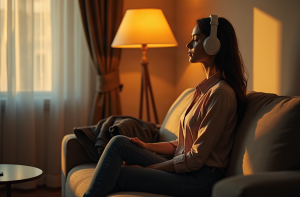
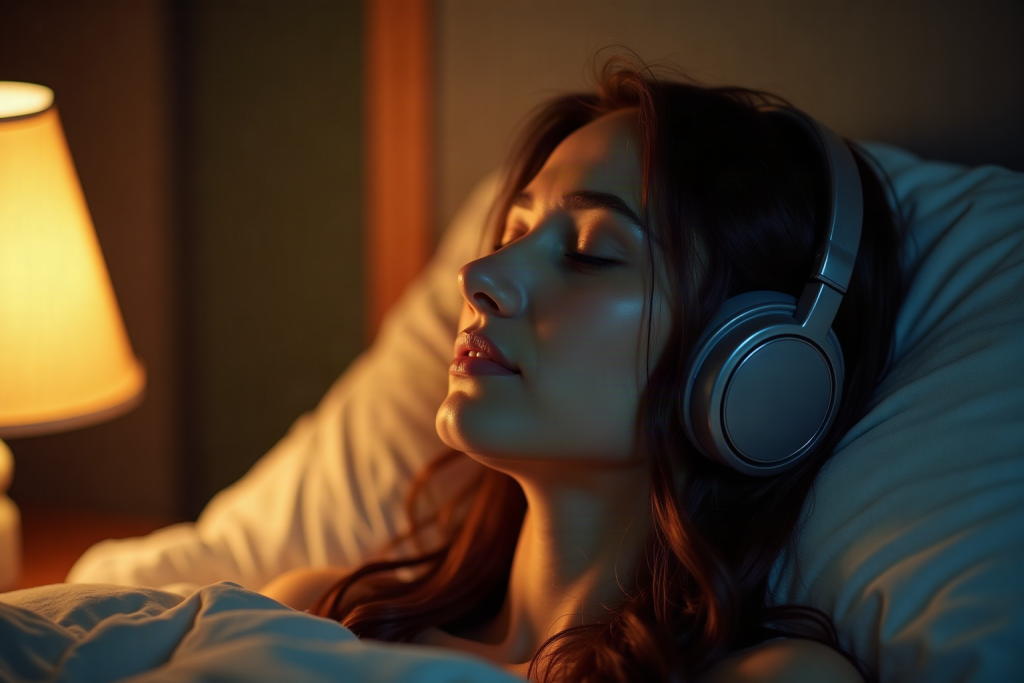
Someone taps a fingernail softly on a wooden table — twice — and a warm ripple rolls across your scalp and down your neck. A voice murmurs a few words at close range. Pages turn. A hand folds a towel with exaggerated care. For millions of people, these ordinary sounds produce an extraordinary feeling: the “brain tingles” known as autonomous sensory meridian response, or ASMR. The interesting question is why ASMR works at all — and the answer is neither mystery nor placebo. It is a measurable chain of events: attention captured without demand, threat appraisal switched off, and a nervous system finally permitted to downshift. That chain explains something more important than the tingles themselves — it explains why deliberate relaxation so often fails while a quiet sound doing nothing in particular succeeds.
This article covers the mechanisms researchers have actually measured, what brain imaging shows about people who experience ASMR, why the relaxation industry keeps missing the point, and a 21-day practice for turning a pleasant accident into a trained downshift you can use on purpose.
Why ASMR Works: Three Mechanisms Behind the Tingles
ASMR is not sleep, not hypnosis, and not a fringe internet ritual. It is a sensory state with a reproducible physiological signature, and three mechanisms do most of the work.
-
It captures attention without demanding anything back. Your brain’s alerting system spends all day asking one question: is this relevant to me, and does it threaten me? Most relaxation attempts fail at exactly this point, because “calm down” is an instruction that keeps the monitor running. ASMR flips the arrangement. A soft, close, low-stakes sound is engaging enough to occupy the scanning system completely, while signaling zero stakes — no plot to follow, no question to answer, no performance to rate. Attention locks on, and the guard duty stands down not because you ordered it to but because it has nothing left to guard against.
-
It moves the body, not just the mood. In a two-part study, watching an ASMR video reliably increased pleasant, calm feelings in people who experience ASMR — and in the experimental arm, heart rate went down while skin conductance went up (Poerio, Blakey, Hostler & Veltri, PLoS ONE, 2018). That combination is the signature worth noticing: a slower heart rate is the parasympathetic brake engaging, while raised skin conductance means the mind is engaged, not sedated. ASMR produces alert calm — present and absorbed at the same time. Most relaxation products deliver either keyed-up distraction or dull drowsiness; ASMR delivers both poles at once.
-
It simulates personal attention. The most reliable triggers in survey research are whispering and one-on-one attention scenarios (Barratt, Spence & Davis, PeerJ, 2017) — a voice speaking softly and close, as if just for you. These are the acoustic signatures of affiliative care: the sounds of one person attending to another at close, safe range. The brain’s social-circuitry response does not require the attention to be genuine. Simulated care still reads as care, and the nervous system responds accordingly.
None of this is mystical. It is sensory input doing regulatory work underneath your conscious agenda — which is precisely why your conscious agenda is such a poor tool for relaxation in the first place.
What the Neuroscience Says About Brain Tingles
The research base is young — the founding survey appeared only in 2015 — but the findings point in a consistent direction.
Barratt and Davis (PeerJ, 2015) surveyed 475 people who experience ASMR and found it reliably produces calm, relaxation, and a flow-like absorption — with sleep help among the most commonly cited uses. That single dataset established ASMR as something worth studying rather than a curiosity of video culture.
Brain imaging followed. Smith, Fredborg and Kornelsen (Social Neuroscience, 2017) scanned ASMR-experiencers at rest and found reduced functional connectivity between prefrontal control regions and the default mode network — the mind-wandering system. The interpretation offered by researchers is diminished top-down inhibition: in people prone to ASMR, sensory and emotional input reaches deeper processing with less gatekeeping. The tingles are not the point of the finding; the finding is that these brains are built to let feeling through.
And the physiology is real. The 2018 PLoS ONE measurements — reduced heart rate, increased skin conductance, elevated calm — show ASMR is a distinct physiological event, not a pleasant story people tell about their mood.
Hold one caveat honestly: the studies are small, and effect sizes vary. But “young field with converging evidence” is very different from “unverified internet phenomenon.”
Why You Can’t Order Yourself to Relax (The Subconscious Problem)
Here is the trap: the harder you try to relax, the more wired you become. Calm is not an instruction your conscious mind can execute. Relaxation is a descent run by the automatic layer of your nervous system — and when you monitor it (“is it working yet?”), you re-engage exactly the vigilance you were trying to switch off. Trying to relax is a task, and tasks keep the arousal system on duty.
The relaxation industry keeps selling tools that make this worse. Meditation apps gamify streaks and grade your sessions. Sleep trackers score the night and hand you a report at dawn. Breathing reminders buzz at scheduled intervals. Every one of them drags you back into measurement mode — evaluation, comparison, judgment — at the exact moment your nervous system needed to stop being evaluated. You relax worse, then study the data about relaxing worse.
ASMR bypasses the gatekeeper because the stimulus, not the will, does the work. Nobody “tries” to feel a tingle and succeeds; the response arrives from the bottom up, delivered by sound that occupies attention and drops the guard. Structured hypnosis audio extends the same logic: once the absorbed state is reached, suggestion can reach the automatic layer directly — rehearsing the experience of letting go rather than issuing orders that layer has ignored for years. That is the shared principle — stop commanding the surface and give the deep system something better to do.
How to Use ASMR Deliberately: A 21-Day Practice
A tingle you stumble into is entertainment. A tingle your nervous system knows how to find is a tool. The difference is repetition — the same trigger, the same sequence, the same time of day, long enough for the subconscious to convert the ritual into a cue. Here is the practice.
Step 1: Fix one trigger set and one session. Choose a single ASMR audio and commit to it for the full 21 days; variety is the enemy of conditioning. A structured session like Coil — The Sleep Descent removes the guesswork — it is built as one guided descent with a consistent arc, rather than an endless stream of unrelated triggers, so there is a single pattern for your brain to learn. Same time each day, same volume, low and constant.
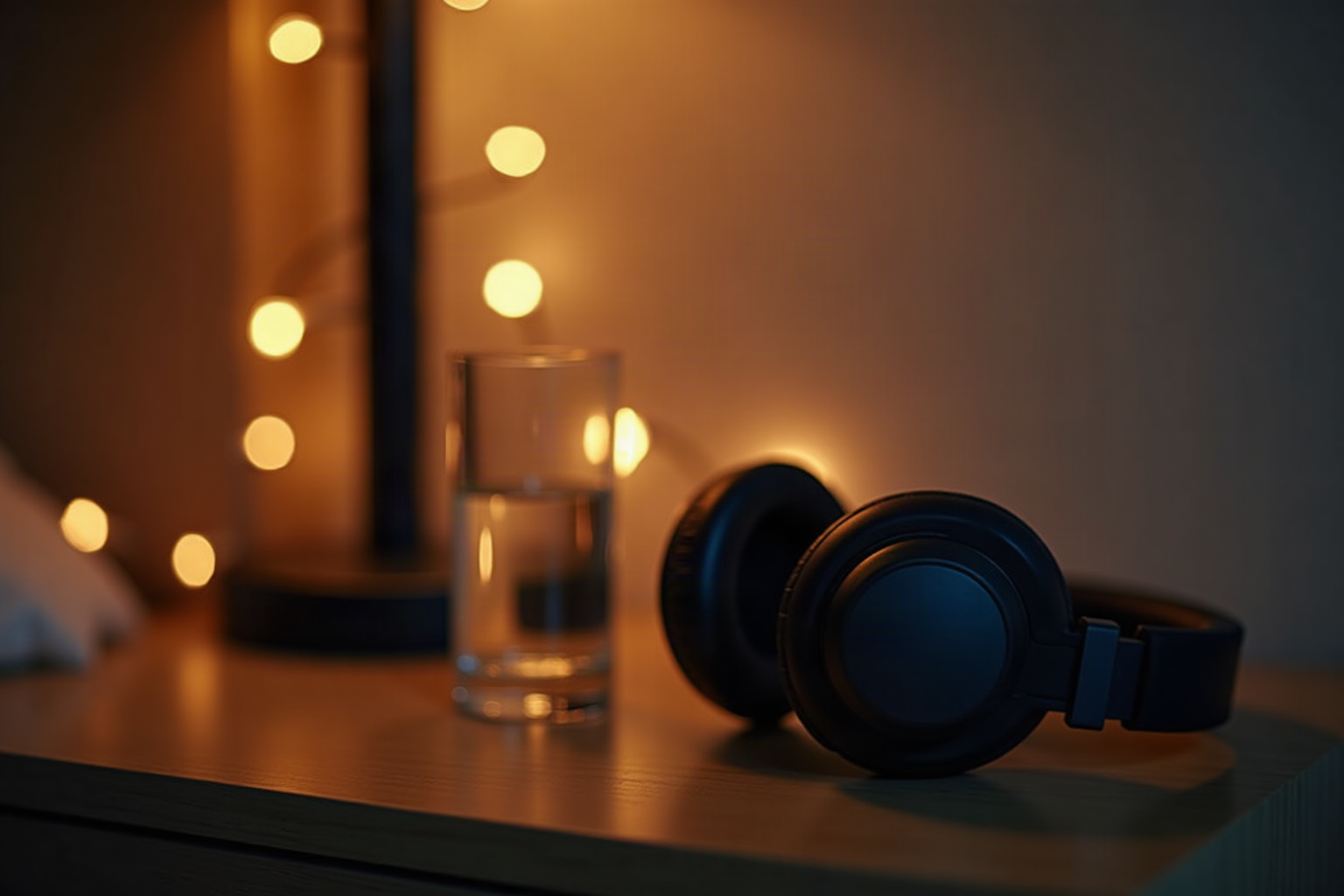
Step 2: Stage the environment identically every time. Headphones on, lights dimmed, phone out of arm’s reach. Run the same two or three small actions in the same order before the audio starts — lights down, water on the table, sit. You are building the front half of a conditioned sequence, not decorating a routine.
Step 3: Follow one sound at a time. Once the audio begins, pick one element — the whisper, the tap, the page turn — and follow it the way you would follow a slow pendulum. When the mind wanders, return to the sound without commentary. Do not chase tingles and do not check whether you are calmer. You are not trying to relax; you are trying to listen.
Step 4: Pair one physical cue. As the audio begins, perform one repeatable physical action every session — three slow exhales, or letting your shoulders drop with a long out-breath. Paired with the sound across three weeks, this becomes a second trigger, one that stays available on days without headphones.
Step 5: Repeat for 21 days and judge in weeks. Expect little in week one — you are laying track. Many people report the response arriving sooner in weeks two and three, with the cue starting to fire before the audio ends. Miss a day? Resume, do not double up. Conditioning is measured in weeks, not sessions.
Frequently Asked Questions
What if I don’t get tingles?
Then you are in roughly the half of the population that does not experience ASMR — and the practice can still serve you. A 2022 psychophysiology study found that heart rate dropped during ASMR viewing in every participant, including those reporting no tingles at all. Treat the audio as a structured attention anchor: the mechanisms you are installing — occupied attention and a conditioned sequence — do not require the tingles.
Is ASMR scientifically proven, or just internet hype?
The honest answer is “young but real.” The field starts in 2015 with the Barratt and Davis survey, has replicated physiological findings since 2018, and has early imaging evidence of distinct brain-network patterns in ASMR-experiencers. Small samples are a fair criticism. What skeptics cannot dismiss is that the same direction — calm, absorption, physiological downshift — keeps appearing across independent labs and methods.
Why do those same sounds make some people furious?
That condition has a name too: misophonia. For people with it, the same soft, repetitive sounds that produce tingles in others produce irritation or disgust — and the misophonic response appears to travel similar sensory circuitry in the opposite emotional direction. Triggers are nervous-system-specific; if a sound sets your teeth on edge, it is the wrong trigger for you, not a personal failure.
Can ASMR treat anxiety or insomnia?
No — and be wary of anyone claiming otherwise. ASMR is a relaxation aid, a state you can practice summoning, not a treatment for an anxiety disorder or a clinical sleep condition. Chronic anxiety or persistent insomnia deserve professional care, with evidence-based treatments like CBT-I for insomnia. Use this practice as a complement, not a replacement.
The Focus–Sleep–Weight Triangle
A trained downshift does not stay in the evening. It runs the rest of your day through the triangle that connects focus, sleep, and weight. The focus engine itself is Gaze — The Fixed Point, a single-point attention audio for deep work. The stress-eating loop that hijacks afternoons is worked at its root by Hunger — The Shedding. And the corner this article is about — the deliberate descent into calm — is Coil — The Sleep Descent. Strengthen one corner and the other two get measurably easier, which is why the three audios are designed to run as a system.
Let the Soundscape Do the Work
You have spent enough evenings commanding your own nervous system to relax and watching it refuse. Give the job to the layer that actually runs the descent: one soundscape, one sequence, twenty-one days of repetition. Start tonight with Coil — The Sleep Descent, and let your subconscious do the heavy lifting.
~ 8 min read · More articles →