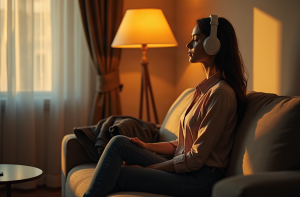

It’s 1 a.m. Your body is exhausted, but your mind has started its late shift — replaying the meeting, rehearsing tomorrow, inventorying every outcome you can’t control. You’ve tried the breathing apps and the sleep podcasts. What finally helped, oddly enough, was a stranger on the internet whispering about rain.
That’s not a coincidence, and you’re not unusual. Using ASMR for anxiety is one of the fastest-growing self-soothing habits in the world, and the reason it works has less to do with tingles than with states. A whisper is a safety signal your nervous system reads before your thinking mind gets any say in the matter.
Anxiety was never mostly a thought problem. It’s a state problem — a nervous system running its alarm sequence — and states can’t be argued out of from the conscious level. They have to be led down from below, through the body. That is exactly the route whispered audio takes, and it’s why pairing ASMR triggers with structured hypnosis audio tends to outperform either one alone.
This article covers what actually happens in your body during ASMR, what the research does and doesn’t support, why anxiety is a subconscious problem in the first place, and a five-step nightly protocol you can run for the next 21 days.
How ASMR for Anxiety Works on a Racing Mind
ASMR — autonomous sensory meridian response — is the warm, wave-like relaxation some people feel in response to soft speech, slow deliberate sounds, and close personal attention. Think of it as a light trance state with a tingling signature. Not everyone experiences it, but the parts that matter for anxiety relief aren’t the tingles. They’re the state changes around them, and they run through three mechanisms:
- Competitive attention. Rumination is a bandwidth problem. The catastrophizing loop needs attention to run, and a whispered video demands just enough tracking — the softness forces you to lean in — to occupy the channel. You cannot fully follow a quiet voice and simultaneously run the disaster reel. The whisper wins the bandwidth, the same way a hypnotic fixation point does.
- Parasympathetic signaling. Your nervous system reads vocal acoustics — pace, volume, pitch contour — before it processes the words. Loud, fast, unpredictable sound pattern-matches to alarm. Soft, slow, close speech pattern-matches to safety, and the body answers by downshifting: heart rate falls, breathing slows, muscles release. ASMR triggers are essentially concentrated doses of the acoustic profile of calm.
- Simulated personal attention. The most popular ASMR formats — the quiet stylist, the soft-spoken medical exam, the librarian murmuring at the desk — simulate being calmly attended to, one-on-one. For a social species, calm personal attention is one of the oldest safety cues there is. The response doesn’t care that the attention is simulated; the circuit fires anyway.
Hypnosis formalizes all three. A hypnotic induction narrows attention, drives the same parasympathetic downshift, and then — while the guard is down — delivers suggestions that a trigger video never makes. ASMR gets you to the door of the state. Hypnosis walks you through it and does renovation work inside.
What the Research Actually Says
The science is young but consistent so far — and worth reading honestly.
The first academic survey, published in PeerJ in 2015 (Barratt and Davis, “Autonomous Sensory Meridian Response (ASMR): a flow-like mental state”), found that people reliably described ASMR as a flow-like state: calm and alert at the same time. Many respondents specifically reported using ASMR videos to manage stress, anxiety, and insomnia symptoms.
The best physiological evidence followed in 2018, when researchers measured people watching ASMR videos (Poerio et al., PLoS ONE). In ASMR-experiencing viewers, heart rate dropped by a few beats per minute on average during the videos — a reduction in the same range reported for mindfulness-based relaxation — while skin conductance rose. That combination (calm body, engaged mind) matches the flow-like description and separates ASMR from plain drowsiness.
Brain imaging points the same direction. An fMRI study published in Social Neuroscience in 2017 (Smith, Fredborg, and Kornelsen) found that people who experience ASMR show altered functional connectivity in the default mode network — the mind-wandering, self-referential system that produces rumination. Rumination is the engine room of anxiety; a trigger state that quiets default-mode processing is, mechanically speaking, a state that starves the worry loop of fuel.
The honest caveats: sample sizes are small, participants self-select, and nobody should claim ASMR treats an anxiety disorder. What the studies do support is narrower and still useful — in responsive people, ASMR produces measurable, physiology-level relaxation on demand, at essentially zero cost.
Why Anxiety Is a Subconscious Problem
Your conscious mind is serial and slow — one deliberate thought at a time. Your threat system is parallel and fast: it reads the environment, fires body changes, and installs the state before the conscious mind has finished parsing what’s happening. By the time you notice “I’m anxious,” the state is already running.
This is why reassurance so rarely works, including your own. Telling yourself to calm down is a conscious message sent to a subconscious process, delivered after the fact. It argues with the narration while the body keeps the score. Breathing apps and productivity tricks fail for the same reason: they treat anxiety as a content problem when it’s a state problem, and the state is held below awareness by predictions that never got your vote.
Whispered ASMR and hypnosis both work bottom-up. Change the body’s inputs — sound, rhythm, narrowed attention — and the state follows the body. And once you’re in that downshifted state, the critical faculty that normally counters new ideas (“sure, but what if…”) goes quiet. That’s the window: suggestions delivered inside the state actually land, instead of being argued with at the door. Do it nightly and the pairing compounds — the sound becomes a conditioned safety cue, which is how states stop being borrowed and start being owned.

The 5-Step Nightly Protocol for Quieting Anxiety
This protocol runs once per evening for 21 days. The goal is conditioning: a repeated pairing of trigger sound, downshifted state, and calming suggestion, until the sound itself starts doing the work.
Step 1: Book the descent. Twenty to thirty minutes before sleep, headphones on, lights low, phone face down. Start with Coil — The Sleep Descent, the Nosaj audio built around a whispered descent into trance. The same architecture that carries you into sleep doubles as an anxiety off-switch, because a racing mind at bedtime is sleep anxiety wearing pajamas.
Step 2: Fix your trigger set. Pick two or three whisper or sound triggers — a specific voice style, soft tapping, rain — and use the same ones every night. Novelty is entertainment; repetition is rewiring. Conditioning needs a consistent cue.
Step 3: Add the long exhale. During the audio, breathe in for a count of four and out for a count of eight. The extended exhale engages the vagal brake — your body’s built-in parasympathetic lever — while the audio handles attention. Inputs from two directions, one destination: down.
Step 4: Attach one suggestion. At your calmest moment in the session, repeat a single present-tense phrase silently: “This sound means I’m safe.” One sentence, delivered inside the state. A paragraph spoken outside the state is worth less than one sentence inside it.
Step 5: Track the drop. Rate your anxiety 0-10 before and after each session. Most people who respond see the post-session drop first and the daytime change second. You’re looking for a trend across 21 days, not a miracle on night one.
Frequently Asked Questions
Does ASMR work for everyone?
No — and honesty here matters. A meaningful share of people feel nothing from ASMR triggers, and a smaller group finds whisper audio actively irritating rather than calming. Responsiveness appears to be a trait, like perfect pitch: you have it or you don’t. If the tingles don’t show up for you, the relaxation response may still arrive — and hypnotic audio without ASMR triggers is a perfectly good fallback.
Can ASMR for anxiety replace anxiety treatment?
No. ASMR is a relaxation practice, not a treatment for anxiety disorders, and nothing in this article is medical advice. If anxiety is interfering with your work, sleep, or relationships, work with a qualified professional. Think of whispered audio as a supplement to care, never a substitute for it.
Why do whispers calm me but irritate other people?
Same stimulus, opposite nervous-system responses. Trait differences in sensory processing mean one person’s safety cue is another’s scratch on a chalkboard. It says nothing about who is “normal.” It also means you shouldn’t broadcast your session at full volume to a partner who doesn’t share the wiring.
What if it doesn’t work for me?
First, check the boring variables: volume too high, wrong triggers for you, inconsistent schedule, or one hand still on your phone. Then try a hypnotic audio without ASMR triggers — the active ingredient is the descent and the suggestion, not the tingles. If 21 consistent days produce nothing measurable, the mechanism wasn’t matched to your wiring. That’s data, not failure — and it’s exactly why the pre/post ratings in Step 5 matter.
Where Calm Fits: The Focus-Sleep-Weight Triangle
Anxiety doesn’t stay in its lane. It steals sleep, fragments attention, and pushes stress-eating — which is why the Nosaj audio line is built on one induction architecture aimed at three different loops:
- Coil — The Sleep Descent — the whispered bridge from a racing mind to deep sleep.
- Gaze — The Fixed Point — fixed-point attention training for a scattered, distractible day.
- Hunger — The Shedding — repatterns the stress-eating loop at its subconscious root.
They compound. Calm makes sleep easier, sleep makes focus possible, and a regulated nervous system loosens the kitchen’s grip.
Let the Whisper Do the Heavy Lifting
If anxiety gets loudest at night, start tonight. Headphones, lights low, twenty minutes of Coil — The Sleep Descent, repeated for 21 days. You don’t have to think your way out of a state your thinking mind didn’t create. Stop arguing with the alarm — and let your subconscious do the heavy lifting.
~ 7 min read · More articles →