
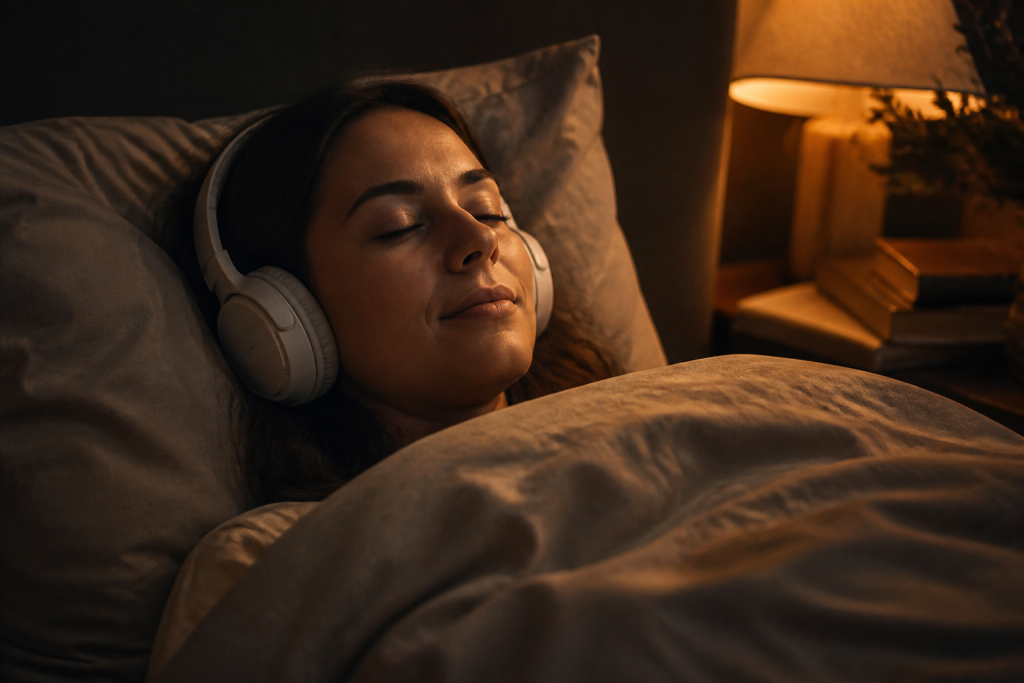
It is 12:47 a.m. Your body has been horizontal for an hour, the room is dark, the phone is face-down — and your brain has convened a meeting you never agreed to attend: the email from 4 p.m., re-litigated; the sentence you should have said in the meeting, re-cast; tomorrow’s calendar, re-sequenced again; a conversation from 2019, remastered. You didn’t choose any of it. The loop chose you, and it does not respond to “just stop thinking about it.”
ASMR for overthinking approaches the problem from the side it actually lives on. This state has a clinical name — pre-sleep cognitive arousal: racing thoughts at night that hold arousal high while everything else in the body is signaling down. It is one of the most reliable predictors of difficulty falling asleep (Harvey, Behaviour Research and Therapy, 2002), and it runs on the subconscious layer, where instruction-giving does not work. “Stop thinking about it” is itself a thought. The loop eats instructions for breakfast.
Instead of arguing with a runaway mind, ASMR changes the sensory input the mind is running on: soft, patterned, low-demand audio through headphones that gives attention somewhere better to sit and lets the body downshift first — so the thoughts lose their fuel rather than their fight. Below: what ASMR actually does to an overactive mind, the physiology behind the brain tingles, and a 21-night protocol for quieting the loop at its source.
How ASMR for Overthinking Works: Three Mechanisms
ASMR — autonomous sensory meridian response — is the wave-like, tingling relaxation some people feel in response to quiet, deliberate stimuli: whispering, gentle tapping, fabric brushing, slow hand movements near a microphone. The tingle gets the headlines. For an overthinking brain, the useful part is what the input does to attention and arousal before and beyond the tingle. Three mechanisms do the work.
It gives attention a soft landing pad. Overthinking is attention without a container. The same focus you use to run a meeting or debug a problem, pointed at nothing, will manufacture threats by default. ASMR triggers are low-stakes, patterned, and predictable: a tap at a steady interval, a whisper at a consistent proximity. They occupy the attentional channel fully while demanding nothing back. That combination — full occupancy, zero demand — is nearly impossible to find anywhere else in your evening. A good ASMR track holds attention gently enough that the loop’s content has nowhere to load.
It downshifts the body first. The order of operations matters, and most people have it backwards: you cannot think your heart rate down. In a controlled 2018 study, listeners who experienced ASMR showed a measurable drop in heart rate alongside increased skin conductance — a state of relaxed alertness that looked nothing like a placebo response (Poerio, Blakey, Hostler & Veltri, PLOS ONE, 2018). The body went first. This is why ASMR can work on nights when self-talk fails: sensory input adjusts arousal below the level where argument lives. When the body’s alarms quiet down, racing thoughts lose their fuel supply.
It replaces the loop’s input channel. Rumination is a closed system — it runs on internal audio: rehearsed conversations, imagined futures, replayed mistakes. ASMR supplies an external sensory signal at the same channel the loop uses, and it does it with the loop’s most effective weapon turned to your advantage: voice. A whisper is close, personal, and attentional — the auditory signature of being cared for. The nervous system reads that proximity as a safety cue long before the conscious mind has an opinion about it. When the loop is generating anxiety-flavored content, a calm voice generating presence-flavored content is not a distraction — it is competing programming.
The Science: Brain Tingles, Heart Rate, and the Default Mode Network
Two findings anchor the science.
First, the physiology is real. The 2018 study above was designed to separate ASMR from belief: heart rate slowed measurably in experiencers during ASMR audio while skin conductance rose — the signature of a genuinely relaxed but engaged state (Poerio et al., 2018, PLOS ONE). That matters because pre-sleep cognitive arousal is fundamentally an arousal problem: the thoughts are unpleasant mainly because the body is still running day-state machinery. Change the machinery, and the same thoughts arrive with less force.
Second, the brains differ in a way that fits the mechanism. In an fMRI study, people who experience ASMR showed atypical functional connectivity between the prefrontal cortex and the default mode network — the large-scale brain network most active when attention turns inward, replaying the past and simulating the future (Smith, Fredborg & Kornelsen, 2017, Social Neuroscience). The default mode network is rumination’s home turf. It is why overthinking spikes when external anchors disappear: nothing holds attention outward, the network turns fully inward, and the loop runs unopposed.
Against that picture, ASMR’s mechanism is sensible: it is an external anchor quiet enough not to re-engage day-state arousal, but engaging enough to keep the inward spiral from taking the whole channel. Honest framing: nothing about this deletes thoughts by force. ASMR outcompetes the loop — it wins the channel, and the loop quiets from lack of fuel.
Why Overthinking Is a Subconscious Problem
Here is the trap most people fall into at midnight: treating the loop as a reasoning problem that a better argument could close. It is not. Thought suppression famously backfires — in the classic white-bear experiments, people instructed not to think of a thought ended up thinking about it more, because the mind must keep checking whether the thought has returned (Wegner, Journal of Personality and Social Psychology, 1987). Trying to stop overthinking is a process that guarantees continued overthinking.
The reason is structural. Conscious attention is a small, effortful, easily depleted system. The loop runs on the substrate below it — the same layer that manages heart rate, breathing, and conditioned threat response — and that layer does not take dictation; it takes repetition and input. This is why the standard toolkit keeps disappointing: productivity systems organize tomorrow (the loop re-litigates yesterday), meditation apps demand effort at the hour you have the least of it, and white-noise machines fill the channel with sound that has no structure for attention to hold. Each addresses the symptom from the outside.
ASMR works the other way: it is input delivered directly to the state system, in the state’s native language — sensory signal, voice proximity, rhythm, safety. And because the loop itself was trained by repetition — thousands of nights of practicing worry at the same hour in the same bed — it can be retrained the same way. Not by one heroic night of silence, but by a run of consistent nights that teaches the subconscious what lights-out means. That is what the protocol below installs.
The 21-Night Quiet-Mind Protocol
The goal is not one perfect night. It is a trained default: the same sensory cue, at the same hour, for enough nights that the loop loses its slot in the schedule. Twenty-one nights, deliberately boring, deliberately consistent.
Step 1: Fix one structured soundscape and commit to it. Variety is the enemy of conditioning. Choose a single session and use it for all 21 nights. A structured soundscape like Coil — The Sleep Descent is built for exactly this: one guided descent rather than an endless feed of random triggers, so the subconscious learns one consistent arc — down, not sideways. Use over-ear headphones at a low, constant volume; speakers scatter the proximity cues that make whispered audio work.
Step 2: Anchor the hour. Start the session at the same time every night, within about fifteen minutes. Conditioning needs a stable context: same cue, same hour, same bed. A soundscape that starts at 11:00 some nights and 1:30 others is a stranger, not a signal.
Step 3: Park the day on paper first. Five minutes before the session, write down every open item the mind is carrying — unfinished tasks, unsent replies, tomorrow’s first move. Rumination is partly rehearsal for things the brain fears losing; paper is a storage medium it can actually trust. This is not journaling for insight; it is offloading the loop’s cargo so the session is not competing with it.
Step 4: Let the audio be the last input. No phone, no headlines, no email after the session starts. If the mind grabs a thread mid-descent — it will, some nights — return attention to the sound without commentary. No self-criticism; just come back to the whisper. That return, repeated, is the rep — attention returning to a scaffold, the same muscle meditation trains.
Step 5: Run the 21 nights and judge by weeks. Expect little in week one — you are laying track, and the loop does not vacate on notice. Many people report the shift arriving in week two or three. One honest note: the “21 days” of pop psychology is not a magic deadline — habit research found automaticity takes a median of 66 days to form (Lally et al., European Journal of Social Psychology, 2010). Treat 21 nights as the commitment window that makes repetition possible, then keep going if the results are arriving. Missed a night? Do not double up. Resume.
Frequently Asked Questions
Does ASMR work if you don’t get tingles?
Often, yes. Survey research found relaxation and sleep are the most-cited reasons people watch ASMR, and a meaningful share of viewers never experience the tingling sensation at all (Barratt & Davis, PeerJ, 2015). The tingle is a bonus, not the mechanism — the calm-down effect comes from the structured, low-demand audio itself. If whispering does nothing for you, test other trigger types — tapping, brushing, rain — for a week each before deciding ASMR isn’t for you.
Is this just distraction with extra steps?
No — and the difference matters. Suppression (“don’t think about it”) paradoxically strengthens the loop. Effortful distraction competes for attention but adds load at the hour you have the least of it. ASMR is displacement with near-zero effort: attention has somewhere better to sit, and the body’s arousal system downshifts first. You are not pushing thoughts away; you are giving them competition they lose.
Can ASMR replace therapy or anxiety treatment?
No. Occasional night-time overthinking is a state. Persistent rumination, all-day anxiety, intrusive thoughts, or low mood that will not lift are conditions, and they belong with a clinician or therapist. ASMR is a wind-down input for the nervous system, not a treatment for an anxiety disorder — and if racing thoughts regularly cost you sleep for weeks at a time, raise that with a doctor too.
What if it doesn’t work?
Audit the frame before judging the method: one soundscape, same hour, phone parked after lights-out, headphones not speakers, a full 21 nights — not a verdict at night three. If the trigger style is wrong, switch types for the next week. If consistent quiet audio still does nothing, move to spoken-word guided sessions — same channel, more structure. And if the rumination persists regardless of input, that is information: talk to a professional, because the loop may be carrying something a bedtime protocol cannot unpack.
The Focus–Sleep–Weight Triangle
The overthinking loop lives in the sleep corner, but the corners share walls. A night spent in cognitive arousal produces exactly the depleted, distractible next day that makes focus impossible — the loop Gaze — The Fixed Point trains against with single-point attention for deep work. And a depleted, sleep-short brain overweights stress and reaches for fast relief — the stress-eating loop Hunger — The Shedding works on at its root. Coil — The Sleep Descent, the anchor of this article’s protocol, covers the sleep corner. The three audios are designed as a system: fix the corner you’re standing on tonight, and the other two get measurably easier.
Give the Loop Some Competition
Midnight is not the hour to out-argue your own brain. It is the hour to change the input. Set a wind-down hour, park the day on paper, press play on Coil — The Sleep Descent, and let your subconscious do the heavy lifting. Twenty-one nights from now, the room will be just as dark at 12:47 a.m. What runs in it will be different.
~ 9 min read · More articles →