
ASMR for Panic Attacks: A Grounding Protocol for the Spike
It starts without asking permission. You’re walking to the car, or sitting in a meeting, or trying to fall asleep — and suddenly your chest seizes, your heart accelerates, your hands go cold, and a voice in your head announces that something catastrophic is happening right now. The worst part is the arbitrariness: the situation is ordinary, often calm. Nothing dangerous is present. But your nervous system has decided otherwise, and arguing with it simply does not work. If you’ve done the rounds — breathing apps, grounding techniques, telling yourself it’s “just a panic attack” — you know the humbling truth: knowing it’s a panic attack and stopping it are two different skills.
Here’s why: a panic spike is not a conscious event. It is a threat response generated below the level of thought — the body’s alarm system misfiring, run by the subconscious, complete before you get a vote.
ASMR for panic attacks works from exactly that layer. Autonomous sensory meridian response — the deep calm-and-tingles reaction to slow, gentle, personal sound — is one of the most reliably down-regulating inputs a nervous system can receive. It does not coach you through logic. It changes the state beneath the logic. Below: what ASMR actually does to a body mid-spike, why the panic loop lives below consciousness, and a 21-day protocol that trains the baseline — not just the moment.
How ASMR for Panic Attacks Actually Works
Panic is a state problem with a thought soundtrack. The physical signature — racing heart, rapid shallow breath, tight chest, dizziness, the sense of impending doom — is sympathetic nervous system activation running hot. ASMR interrupts that signature at three distinct points.
It down-regulates arousal in real time. The physiological effects of ASMR have been documented in controlled settings. In a 2018 study at the University of Sheffield and the University of Essex, participants watching ASMR content showed a significant reduction in heart rate compared with controls — a pattern consistent with parasympathetic activation, the “stand down” branch of the autonomic nervous system (Poerio et al., PLOS ONE, 2018). That matters for panic specifically: the spiral is driven by escalating bodily arousal sensed as threat. An input that reliably lowers heart rate interrupts the spiral at its physical base, before the thought loop can feed on it.
It captures attention away from the body. Panic is maintained by interoceptive hypervigilance — the anxious mind scanning inward for the next sign of trouble. Once attended to, bodily signals are amplified and misread as danger, producing more arousal, more signals — the classic panic crescendo. ASMR is attentional glue for the external world. Whispered narration, slow sounds, and detailed sensory texture are engaging enough that attention has somewhere else to be. The inward threat-scan pauses — and with it, the feedback loop feeding the spike.
It creates a conditioned grounding cue. Here is where ASMR becomes more than a relaxant. In the first systematic study of the phenomenon, many people reported deep relaxation even without tingles — the calm response is robust and trainable (Barratt & Davis, PeerJ, 2015). When a specific, repeatable sound is paired with a deeply calm state, night after night, it becomes a conditioned cue: a trigger the nervous system learns to associate with safety. That is a grounding cue you can carry into the early warning signs of a spike.
Notice what none of this does: argue with the anxious thought. Panic doesn’t respond to argument. It responds to state change.
The Science of the Spike and the Calm Baseline
Panic attacks have a well-characterized physiology. The amygdala — the brain’s threat-detection hub — over-fires, activating the sympathetic nervous system and the hypothalamic-pituitary-adrenal axis, producing the surge of adrenaline and cortisol that drives the physical symptoms. Crucially, this appraisal happens below conscious awareness: by the time you think I’m panicking, the chemistry is already in motion.
Two bodies of evidence make the ASMR-for-panic argument concrete — and honest. First, the calming input itself: slow, rhythmic, low-frequency sensory stimulation — precisely what ASMR and guided relaxation audio provide — has documented effects. A systematic review of slow-breathing techniques found robust psycho-physiological correlates, including increased parasympathetic activity and reduced arousal (Zaccaro et al., Frontiers in Human Neuroscience, 2018). Second, the ASMR-specific data: beyond the 2018 heart-rate finding, subsequent research has characterized the ASMR response as consistent with deep relaxation (Psychophysiology, 2022).
An honest limitation: there is no large randomized trial of ASMR as a treatment for panic disorder. ASMR is an input, not a patented intervention. What the evidence supports is narrower but real: ASMR reliably produces physiological relaxation, slow rhythmic audio engages the parasympathetic system, and repeated pairing of a calm state with a specific cue builds conditioned safety responses. Those are the same active ingredients found in established grounded-care techniques, delivered through a medium you can use in bed.
Why Panic Is a Subconscious Problem
The spike doesn’t consult you because it’s not built to. Panic is a memory-and-threat system doing its job badly: past panic episodes tag interoceptive signals — a slightly elevated heart rate, a hint of breathlessness — as catastrophic. From then on, the alarm fires on the prediction of danger, not its presence. That process is fast, automatic, and entirely below language.
This is why the conscious toolkit keeps failing. Affirmations can’t out-reason a system that has already spoken. Apps that tell you to “just breathe slower” assume you can access deliberate control mid-hijack — when the entire point is that the hijack has taken control from you. Avoiding the situations that trigger spikes works temporarily, but avoidance confirms the threat and deletes the evidence against it, so the trigger list quietly grows.
And the loop was built by repetition — the first spike taught the body what to fear; every subsequent spike rehearsed it. Repetition is also the only currency the nervous system accepts for retraining. That’s why hypnosis and ASMR audio belong in a panic protocol: they don’t argue with the conscious mind, they work around it. Absorbed, listening attention — the state ASMR produces effortlessly — is exactly where suggestion and conditioned learning land. Calm built at that layer, nightly, becomes the baseline the next early warning signal is processed against.
The 21-Day Grounding Protocol
The goal is not to never feel a flutter again. The goal is a nervous system that receives an early warning signal and files it as noise instead of launching a crisis. Twenty-one days, deliberately boring, deliberately consistent.
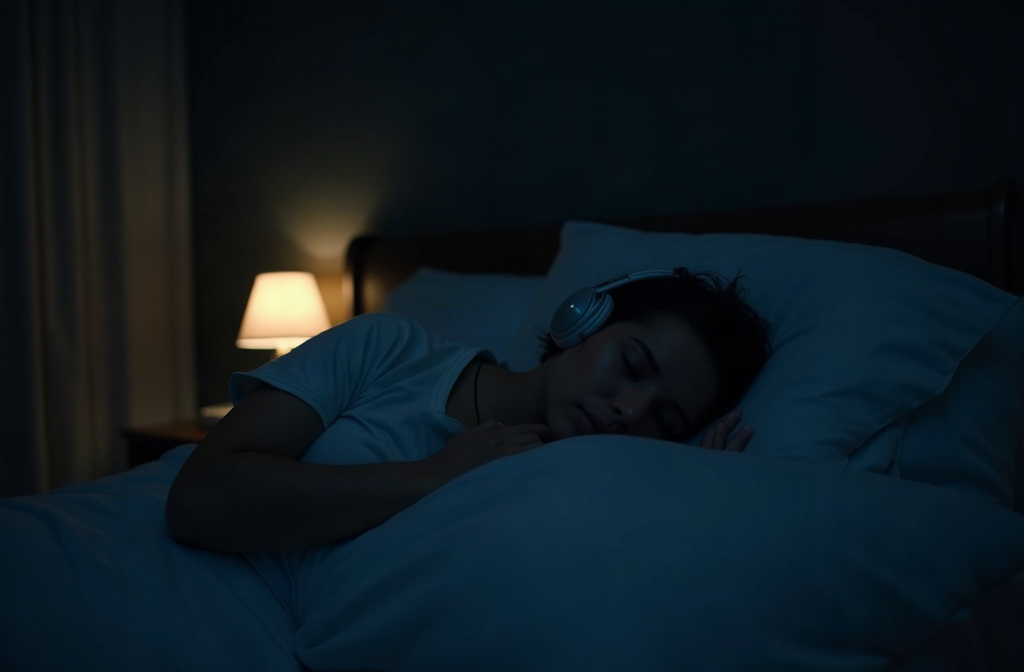
Step 1: Train the calm baseline nightly — one structured hypnosis audio at lights-out. Pick a single session and commit to it for the full 21 days. A structured soundscape like Coil — The Sleep Descent is built as one consistent arc: it carries you down into relaxed, absorbed attention while delivering calm and safety suggestions at the moment the subconscious runs the night shift. Over-ear headphones, low constant volume, session starting at lights-out. Consistency beats variety — the repetition across nights is the intervention, and it gives the nervous system a reliable daily anchor of felt safety.
Step 2: Build your anchor sound. During your nightly session, pick one element of the audio — a recurring tone, a phrase, a texture — and attend to it intentionally each night. This is cue construction: the sound becomes a conditioned grounding signal because it is repeatedly paired with the body’s most relaxed state. By week two, that element will trigger a calm response on its own — a cue you carry into the early-warning window.
Step 3: Practice the spike drill during a calm hour. Once a day, sit for ten minutes, put on your anchor sound, and practice the drill you’ll use in a real early-warning: slow nasal inhale for about four counts, then a long exhale for six to eight. The slow-breathing research found parasympathetic activation reliable enough to recommend as daily practice (Zaccaro et al., 2018) — and the exhale is the one part of the stress response with a manual override. Practice it outside the spike so it’s available inside one.
Step 4: Deploy at the first warning sign — not at full panic. Early warning is a window of seconds to minutes where the alarm is firing but has not yet peaked. The moment you notice the signature — heat, racing pulse, tight chest — sit or lean, anchor on the sound, and start the long exhales. The cue is a state switch, not a distraction.
Step 5: Repeat for 21 days; judge by waves, not by single episodes. Week one is track-laying — expect little. Many people report the shift arriving in weeks two and three: spikes arrive less often, peak lower, and pass faster. If you miss a night, don’t double up — just resume. This trains the baseline you meet the wave with; it is not a promise that waves stop coming.
Frequently Asked Questions
Does ASMR for panic attacks actually work?
It is not a miracle and not a placebo — it is mechanistically reasonable and honestly limited. There is no ASMR-specific randomized trial for panic disorder. What’s documented: ASMR reliably lowers heart rate, slow rhythmic audio engages parasympathetic down-regulation, and repeated calm-state pairing builds conditioned safety cues. Those are real physiological levers, used here as a complement to care — not a substitute for it.
What if it doesn’t work — I never get the tingles?
Tingles are not the active ingredient. In the first systematic study of ASMR, a large share of users reported deep relaxation without the tingling sensation at all (Barratt & Davis, 2015). Responsiveness varies — down-regulation appears in non-tingle responders too. If the audio relaxes you without fireworks, the baseline training still works. The calm is the point, not the sensation.
Can audio stop a full-blown panic attack in the moment?
Often it can blunt one, and sometimes it can’t — and it’s important not to add self-blame if it doesn’t. At full activation, the nervous system may not be reachable by any input for the few minutes the chemistry takes to peak. That is why this protocol puts the nightly baseline first: a cue deployed at the early warning stage is far more effective than one deployed mid-peak. Use audio at both times, but judge the protocol by its effect on the early window.
When is this not enough?
If panic attacks are frequent, unpredictable, or severe enough to change how you live — the territory of diagnosable panic disorder — this protocol is a supplement, not a treatment. Cognitive behavioral therapy, particularly interoceptive exposure, is a first-line treatment with strong evidence behind it. If you are having chest pain or breathing difficulty, that should be assessed medically — never assume it’s “just panic.”
The Focus-Sleep-Weight Triangle
Panic doesn’t live in a vacuum; it lives in a nervous system, and that system has three levers. Sleep sets the floor: a short or fragmented night raises the threat baseline, and a structured session like Coil — The Sleep Descent trains the descent directly. Attention sets the spotlight: scattered focus feeds the inward threat-scan, and Gaze — The Fixed Point trains single-point absorption that gives the mind somewhere external to land. Stress finds its outlet in loops like stress-eating, where Hunger — The Shedding retrains the craving cycle at the subconscious level. Train all three and the nervous system stops meeting ordinary moments from a deficit.
Start Building the Calm Baseline Tonight
You cannot argue your way out of a spike, but you can train your way out of the pattern — one night of absorbed, safe stillness at a time. Twenty-one nights of Coil — The Sleep Descent, headphones on, lights out. Build the cue, practice the drill, and let the next early warning be processed as noise instead of crisis. Let your subconscious do the heavy lifting.
~ 8 min read · More articles →