
You have tried everything. You’ve dimmed the lights, switched to linen sheets, and traded your late-night scrolling for a lukewarm mug of magnesium tea. Yet, the moment your head hits the pillow, the “theatre of the mind” begins its nightly performance. Your brain rehearses an awkward conversation from three years ago, calculates tomorrow’s to-do list, or simply refuses to acknowledge that the day is over. This isn’t just a lack of “sleep hygiene”—it’s a conflict between your conscious desire to rest and your subconscious mind’s refusal to let go.
Most people treat sleep as a physical state you “do,” but sleep is actually a psychological transition you “allow.” When you struggle to fall asleep, it’s rarely because you aren’t tired. It’s because your autonomic nervous system is stuck in a state of high arousal. Your conscious mind wants to sleep, but your subconscious—the part that controls your heart rate, breathing, and the “safety” of your environment—believes you need to stay vigilant. This is why willpower fails. You cannot force yourself to be unconscious. You can only create the internal conditions where unconsciousness becomes inevitable.
Hypnosis is the most effective tool for bridging this gap. Unlike white noise or standard meditation apps that merely provide a distraction, hypnosis audio for sleep targets the subconscious associations that keep you awake. By utilizing specific linguistic patterns and rhythmic inductions, hypnosis bypasses the “Critical Factor” of your conscious mind, guiding your brain waves from the frantic Beta state of daily life into the Alpha and Theta states that precede deep Delta sleep. In this 2026 guide, we will explore why hypnosis is the gold standard for insomnia and how to choose the right audio to finally reclaim your nights.
How Hypnosis Reclaims Your Sleep Architecture
Hypnosis works because it speaks the language of the subconscious. While your conscious mind thinks in words and logic, your subconscious thinks in patterns, associations, and physiological responses. When you listen to a high-quality hypnosis audio for sleep, several specific mechanisms occur simultaneously to transition you from wakefulness to deep rest.
- The Interruption of the Default Mode Network (DMN): The DMN is the brain’s “background” setting, responsible for rumination and self-referential thought. It’s the part of you that worries about the future or regrets the past. Hypnosis provides a structured “external” focus that pulls the DMN out of its loop, effectively silencing the internal monologue that keeps you staring at the ceiling.
- Vagal Tone Activation: Deep hypnotic induction involves rhythmic breathing and progressive muscle relaxation. This sends a direct signal to the Vagus nerve, the “on/off” switch for your parasympathetic nervous system. As your heart rate variability (HRV) increases and your cortisol levels drop, your body receives the biological permission it needs to shut down.
- Subconscious Scripting: Insomnia is often a learned behavior. If you’ve struggled with sleep for months, your brain has built a subconscious association between “bed” and “frustration.” Hypnosis uses post-hypnotic suggestions to rewrite this script, associating the horizontal position and the sound of the audio with an immediate, irresistible descent into relaxation.
By addressing sleep at the subconscious level, you stop fighting against yourself. You aren’t “trying” to sleep; you are simply following a guided path into a state that your body already knows how to achieve.
The Neuroscience of Trance and Rest: Evidence from 2026
The efficacy of hypnosis for sleep is no longer a matter of debate; it is a matter of neurological record. A landmark study published in the Journal of Sleep Research (2024) demonstrated that participants who used hypnosis audio before bed experienced a 45% increase in “slow-wave sleep”—the deep, restorative phase of sleep where the body repairs tissue and the brain clears out metabolic waste.
Using high-density EEG monitoring, researchers found that hypnotic suggestions for “deeper rest” actually increased the power of Delta brain waves. This is significant because most pharmacological sleep aids—while they may knock you unconscious—actually suppress slow-wave sleep, leaving you feeling “hungover” the next morning. Hypnosis, by contrast, enhances the quality of natural sleep cycles.
Furthermore, neuroplasticity studies show that the “Theta” state achieved during hypnosis is the peak window for subconscious reprogramming. By feeding the mind calming, sleep-positive suggestions during this transition, you are essentially “training” your brain to become a better sleeper over time. It is not just a temporary fix; it is a structural improvement in your sleep architecture.
Why Your Willpower (and Your Sleep Apps) Are Failing You
If you’ve tried “calm” stories or standard mindfulness apps and found they only worked for a few nights before losing their charm, there is a structural reason for that. Most sleep apps are designed for relaxation, which is not the same as hypnosis.
Relaxation is a conscious effort. You listen to a story about a rainy day in Paris, and you try to imagine it. This still requires the active participation of your conscious mind. The problem with many insomniacs is that their conscious mind is the very thing that won’t turn off. If you are “trying” to follow a story, you are still “awake.”
Hypnosis is different because it uses “embedded commands” and “confusion techniques” to fatigue the conscious mind until it steps aside. Once the conscious mind is bypassed, the hypnotic suggestions go directly to the subconscious. This is why you might “drift off” and stop hearing the words of a hypnosis track, only to wake up the next morning feeling fully refreshed. The audio wasn’t just entertaining you; it was re-wiring your physiological response to the night.
Willpower is a finite resource governed by the prefrontal cortex. By 11:00 PM, your prefrontal cortex is exhausted. You cannot use a tired muscle (willpower) to force a complex biological process (sleep). Hypnosis offloads the work to your subconscious, which never gets tired and is perfectly capable of managing your sleep cycles without your “help.”
The 21-Day Sleep Descent Protocol
To get the most out of hypnosis audio, you need to treat it as a training regimen, not a magic pill. While many users report results on night one, the structural benefits of subconscious repatterning compound over time.
- Step 1: Select Your Anchor. Choose a high-quality, clinical-grade hypnosis track specifically designed for sleep descent. We recommend Coil — The Sleep Descent. Coil is engineered with binaural underlays and a specific linguistic structure that mimics the natural slowing of the heart rate during the transition to sleep.
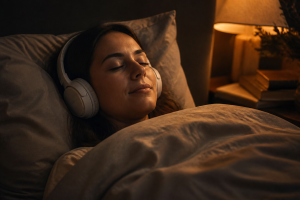
- Step 2: Environment Neutralization. Set your audio to play on a loop or ensure it has a “fade to silence” ending. Use comfortable, sleep-safe headphones or a pillow speaker. The goal is to make the audio the only thing your brain has to process.
- Step 3: The Passive Stance. As the audio begins, do not “try” to follow the instructions perfectly. If your mind wanders, let it. The hypnotic suggestions are designed to work even if you aren’t paying attention. In fact, “tuning out” is a sign that the induction is working.
- Step 4: The 21-Day Commitment. Commit to listening every single night for three weeks. This is the time required for the brain to form new neural pathways. By night 21, the mere sound of the intro music will act as a “Pavlovian trigger,” signaling your body to release melatonin and prepare for shutdown.
- Step 5: Morning Integration. Notice how you feel upon waking. Hypnosis sleep is deeper than drug-induced sleep. You should feel a sense of mental clarity and emotional stability that persists throughout the day.
FAQ: Common Questions About Hypnosis for Sleep
Is it safe to listen to hypnosis every night?
Yes. Unlike chemical interventions, hypnosis is a natural state of focused attention. Listening nightly actually improves your “hypnotic talent,” making it easier for you to enter deep states of relaxation over time.
What if I fall asleep before the audio ends?
That is the goal! Your subconscious mind remains active even when you are asleep. It continues to process the suggestions and “post-hypnotic cues” long after your conscious mind has checked out.
I’ve tried hypnosis and it didn’t work. Why?
Hypnosis requires a specific “buy-in” from the subconscious. If the audio you used was too “new-agey” or lacked a clinical structure, your conscious mind may have rejected it. Quality matters. Additionally, if you only tried it for one or two nights, you didn’t give the neurological associations enough time to form.
Can hypnosis help with “racing thoughts” at night?
Absolutely. This is one of the primary uses of hypnosis. By providing a “structured focal point,” the audio prevents the mind from wandering into stressful territory, effectively “crowding out” the racing thoughts with calming, rhythmic patterns.
The Focus-Sleep-Metabolism Triangle
Sleep does not exist in a vacuum. If your sleep is fractured, your ability to focus during the day will crumble, and your body’s ability to regulate hunger hormones (Leptin and Ghrelin) will be compromised. This is why we often see sleep issues, brain fog, and weight gain appearing together.
To fully optimize your life, you may need to address the other corners of this triangle:
- For Daytime Sharpness: Use Gaze — The Fixed Point to rebuild the focus that sleep deprivation destroys.
- For Metabolic Regulation: Use Hunger — The Shedding to silence the “sugar cravings” that often follow a bad night’s sleep.
By addressing the subconscious root of these three pillars, you create a positive feedback loop that makes every aspect of your life easier to manage.
Conclusion: Let Your Subconscious Do the Heavy Lifting
You have spent enough nights fighting your own brain. The “struggle” to sleep is a battle you are destined to lose because the very act of struggling keeps you awake. It is time to stop fighting and start descending.
By utilizing clinical-grade hypnosis audio like Coil — The Sleep Descent, you are handing the keys to your sleep architecture over to the part of your mind that actually knows what to do with them. Let go of the willpower, let go of the “hygiene” checklists, and simply listen. Your subconscious is ready to take you home.
~ 7 min read · More articles →