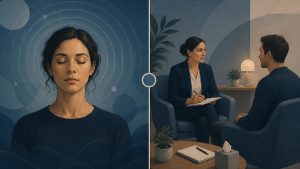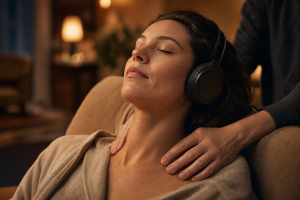
The world of digital relaxation is more crowded than ever. You’ve likely encountered a sea of whispering YouTubers, rhythmic tapping videos, and guided meditations promising to melt away your stress. At the center of this boom are two distinct yet frequently confused phenomena: ASMR and hypnosis.
On the surface, they seem to share a common goal: deep relaxation. Whether you are listening to the gentle crinkle of paper in an ASMR video or the authoritative yet soothing suggestions of a hypnotherapist, the physical result is often a profound sense of calm. However, if you’ve ever found yourself wondering about the specific mechanics—asmr vs hypnosis—and why one might work where the other fails, you aren’t alone.
The confusion stems from the fact that both states involve an altered state of consciousness. But while ASMR is primarily a sensory-driven physiological response, hypnosis is a cognitive-driven psychological process. Understanding the difference isn’t just an academic exercise; it is the key to unlocking the full potential of your mind’s ability to heal, focus, and rest. Most people struggle with stress or insomnia because they are trying to solve a subconscious problem with a conscious solution. Willpower alone cannot force your nervous system to downregulate. By understanding how these two modalities interact with your brain, you can move past the symptoms and address the root cause of your tension.
The Mechanics of Calm: What Hypnosis Does to the Brain
To understand hypnosis, we must move past the stage-show cliches. Hypnosis is a clinical tool used to induce a state of focused attention and heightened suggestibility. It isn’t about losing control; it’s about gaining access to the control panel of your subconscious mind.
When you enter a hypnotic trance, several specific mechanisms occur within your neural architecture:
- Selective Attention and the Thalamus: During hypnosis, the brain’s “gatekeeper,” the thalamus, begins to filter out external stimuli. This allows you to ignore the distant sound of traffic or the itch on your shoulder, focusing entirely on the internal landscape or the suggestions being provided.
- Bypassing the Critical Factor: Every person has a “critical factor”—a conscious filter that compares new information against existing beliefs. Hypnosis temporarily relaxes this filter. If you consciously tell yourself “I am a deep sleeper,” your critical factor might argue, “No, you’re an insomniac.” Under hypnosis, that suggestion can reach the subconscious without being intercepted by your internal skeptic.
- Neural Plasticity and Pattern Matching: The subconscious mind communicates through patterns and metaphors. Hypnosis utilizes these patterns to “re-wire” the brain’s default responses to stress or cravings. It doesn’t just mask the feeling; it changes the underlying neural pathway.
Unlike the passive experience of sensory “tingles,” hypnosis is a structured, goal-oriented process designed to facilitate lasting behavioral change.
The Neuroscience of Trance: Studies and States
The distinction between asmr vs hypnosis is most visible when we look at functional MRI (fMRI) scans. While both involve relaxation, they light up different neighborhoods in the brain.
In a landmark study published in PLOS ONE (2018), researchers found that ASMR triggers activated brain regions associated with reward and emotional arousal, such as the nucleus accumbens and the anterior cingulate cortex. This explains the “euphoric” feeling often reported by ASMR enthusiasts. It is a biological reward for a specific sensory input.
Hypnosis, however, shows a unique signature in the Dorsal Anterior Cingulate Cortex (dacc) and the Default Mode Network (DMN). A study from Stanford University School of Medicine (2016) led by Dr. David Spiegel revealed that during hypnosis, there is a decrease in activity in the dacc, which is part of the brain’s salience network. This effectively turns down the volume on the “worry centers” of the brain. Furthermore, hypnosis increases the functional connectivity between the executive control center (the prefrontal cortex) and the insula—the part of the brain that governs the mind-body connection.
Essentially, ASMR is a sensory reflex, while hypnosis is a targeted executive shift. One is a pleasant reaction; the other is a deliberate reprogramming.
Why Your Problem is Subconscious (And Why Willpower Fails)
If you have ever tried to “force” yourself to sleep or “will” yourself to focus during a high-pressure project, you know that the conscious mind is a blunt instrument. We process about 40 bits of information per second consciously, while our subconscious processes closer to 40 million bits per second.
Most of our struggles—insomnia, procrastination, anxiety, or emotional eating—are driven by subconscious “scripts” written years ago. These are survival mechanisms that have gone haywire. Willpower fails because it is a finite resource managed by the prefrontal cortex. When you are tired or stressed, your willpower evaporates, and you revert to your subconscious defaults.
This is where the asmr vs hypnosis debate becomes practical. ASMR provides a temporary “physiological timeout.” It calms the nervous system in the moment. However, it rarely changes the script. Hypnosis works because it goes around the conscious mind entirely. It addresses the 40 million bits per second, not the 40 bits. By speaking directly to the subconscious, you can update the software of your mind, making “deep focus” or “restful sleep” your new default setting rather than something you have to fight for.
A Practical Protocol for Integrating Both
You don’t have to choose between sensory relaxation and cognitive reprogramming. In fact, they work best when used in a specific sequence. This protocol is designed to help you transition from the high-beta “stress” state into the theta “change” state.
- Preparation with High-Fidelity Audio: Begin by choosing a targeted audio induction. For those struggling with focus and wandering minds, Gaze — The Fixed Point (Product ID 701) provides the necessary cognitive anchor. If your goal is the total cessation of thought for sleep, Coil — The Sleep Descent (Product ID 699) is the superior choice.
- Sensory Priming: Spend the first five minutes of your session focusing on the sensory qualities of the audio—the tone, the rhythm, and the spatial “depth” of the sound. This mimics the ASMR response, triggering a release of oxytocin and dopamine to prime the brain for receptivity.
- Active Induction: As the audio progresses, shift from “listening” to “experiencing.” Allow the suggestions to become your own internal monologue. Do not try to analyze the words; simply observe them as they pass through your mind.
- The Anchor Point: Identify the physical sensation of relaxation in your body—perhaps a heaviness in the limbs or a cooling sensation in the forehead. Mentally “anchor” this feeling to the sound of the audio.
- 21-Day Consolidation: Neural pathways are not built in a single night. To move from a temporary state to a permanent trait, you must repeat this protocol daily for 21 days. This is the minimum time required for the subconscious to accept a new pattern as the “new normal.”
Frequently Asked Questions
Is ASMR just a form of hypnosis?
No. While both can lead to relaxation, ASMR is a reflexive sensory response (often called a “brain orgasm”) to specific triggers. Hypnosis is a cognitive process involving directed attention and suggestibility. You can be hypnotized without feeling ASMR tingles, and you can experience ASMR without being in a hypnotic trance.
Can I be “stuck” in a hypnotic state?
This is a common myth. Hypnosis is a state of heightened focus, not a loss of consciousness. If a fire alarm went off, or if the audio stopped, you would naturally emerge from the state immediately. It is closer to being “absorbed” in a great movie than being asleep.
What if I don’t feel the “tingles”?
Not everyone is “ASMR-sensitive.” Estimates suggest only about 20-30% of the population experiences the specific physical tingling sensation. However, everyone with a functioning brain is capable of some level of hypnotic trance. If you don’t feel tingles, focus on the clinical benefits of the hypnotic suggestions rather than the sensory reflex.
Is this safe for people with ADHD?
Yes, and often highly beneficial. Those with ADHD frequently struggle with an overactive “Default Mode Network” (the “mind-wandering” brain). Hypnosis helps train the brain to suppress the DMN and engage the Task-Positive Network, providing a drug-free way to improve focus over time.
The Focus-Sleep-Weight Triangle
The human mind does not operate in silos. Your ability to focus during the day is dictated by the quality of your sleep the night before. Your ability to resist emotional eating (weight management) is dictated by your stress levels and your brain’s reward centers.
To achieve total optimization, we recommend a holistic approach to subconscious training:
- Gaze — The Fixed Point: For sharpening cognitive performance and deep work.
- Coil — The Sleep Descent: For rapid induction of Stage 3 and Stage 4 deep sleep.
- Hunger — The Shedding: For rewriting the emotional scripts that drive overeating.
By addressing all three points of the triangle, you create a feedback loop of health and productivity that willpower alone could never sustain.
Take the Next Step
The difference between asmr vs hypnosis is the difference between a massage and physical therapy. One feels good in the moment; the other fixes the underlying structure. If you are ready to stop managing your symptoms and start mastering your mind, it is time to move beyond passive relaxation.
Stop fighting against your own biology. Download Gaze — The Fixed Point today and let your subconscious do the heavy lifting.
~ 7 min read · More articles →