

You said you’d go to bed at eleven. At 11:04, one more video. At 11:31, one more scroll. At 12:17 you’re three feeds deep, telling yourself tomorrow will be different — and tomorrow, it happens again. It’s not laziness, and it’s not a weak will. The sleep researchers who named this behavior “bedtime procrastination” found that failing to go to bed on time is strongly linked to self-regulation — the same trait system that governs how you handle cravings, distraction, and delay (Kroese et al., Frontiers in Psychology, 2014). In other words: the stay-up-late scroll is not a bedtime problem. It’s a control problem, run by the part of your mind that doesn’t answer to logic at midnight.
That’s why “just put the phone down” never survives contact with the pillow. By the time you’re deciding whether to close the app, the decision has already been made by a tired, reward-seeking subconscious that knows exactly what dopamine feels like — and knows you’re too depleted to argue.
ASMR for bedtime procrastination works at this level, not above it. Autonomous sensory meridian response — the deep calm-and-tingle reaction to slow, gentle, personal sound — gives the subconscious something more compelling to reach for than the feed, while structured hypnosis audio trains the wind-down itself as a habit the brain actually wants to repeat. Below: what bedtime procrastination actually is, the science of the late-night scroll loop, and a 21-day protocol for replacing it with a descent your brain learns to prefer.
How ASMR for Bedtime Procrastination Works
Bedtime procrastination is defined precisely: going to bed later than intended, with no external circumstances forcing the delay. No work crunch, no sick child, no night shift — just you, the feed, and a bedtime you keep missing. Three mechanisms make ASMR audio a credible intervention for that specific loop.
It hands the subconscious a competing reward. The scroll is not a decision — it’s a reward grab. Each swipe delivers a small dopamine pulse, and a tired brain is a dopamine-seeking brain. ASMR is not nothing in that competition. Many people describe the response as the opposite of a feed: slower, warmer, physically present. A multi-site study from the University of Sheffield measured the actual physiology of the response — participants watching ASMR content showed significant heart-rate reductions compared with controls, a pattern consistent with genuine relaxation rather than mere amusement (Poerio et al., PLOS ONE, 2018). You cannot scroll with the same urgency when your nervous system has begun to descend.
It inserts a frictionless stopping point. The feed is engineered to never end; page after page, there is no natural off-ramp. An audio session is the opposite: it has a beginning, a middle, and an end — a designed descent. Pressing play replaces “one more scroll” with a bounded commitment that takes less effort than deciding. That matters because bedtime procrastination research consistently finds the behavior is tied to low self-regulatory strength late in the day — you are asking a depleted system to make the high-effort choice. Audio makes the good choice the easy choice.
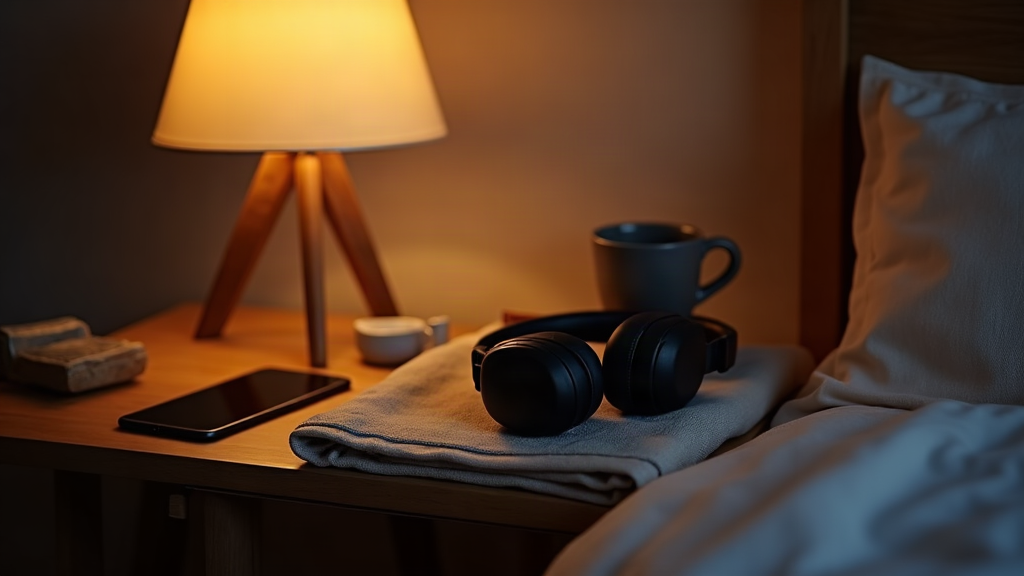
It pairs the cue with the state. The most powerful trigger for the late-night loop isn’t the phone — it’s the association between being in bed, alone, quiet, and reaching for stimulation. ASMR and sleep-oriented hypnosis audio exploit that same window in the opposite direction: dark room, headphones, voice in the ear — the exact conditions of the old scroll habit, now carrying a calm descent instead of a stimulation spike. The old cue, a new response. That is how habits are actually rewritten.
The Science of the Midnight Loop
The evidence that this is a subconscious problem, not a discipline problem, is strong. In the study that introduced the concept, Kroese and colleagues surveyed a large sample and found that bedtime procrastination was common, consistently reported, and predicted shorter sleep and greater fatigue — with the effect of self-regulation central to who delayed and who didn’t (Frontiers in Psychology, 2014). Deliberate effort was the thing that failed. The people who went to bed on time weren’t the ones fighting harder at midnight; they were the ones whose wind-down didn’t require a fight at all.
The neural story matches. The default mode network — the brain’s self-referential, future-forecasting circuitry — stays active during absorbed screen use, and research in the ASMR field found that individuals who experience the response show distinct default-mode connectivity patterns (Smith, Fredborg & Kornelsen, Social Neuroscience, 2017), consistent with ASMR being a genuine state of inward, relaxed attention rather than simple entertainment. The screen itself sabotages descent from the first minutes: blue-rich light at night suppresses melatonin and keeps alertness elevated. The scroll isn’t just filling time — it is actively training the brain to stay up.
One honest limitation: no large randomized trial has tested ASMR as a named treatment for bedtime procrastination. What the evidence supports is narrower and still useful: bedtime procrastination is real, measurable, and powered by low late-day self-regulation; ASMR reliably produces a measurable parasympathetic relaxation response; and repeated calm-state rehearsal at lights-out is exactly the mechanism by which wind-down habits are built. The claims here are about state training — not magic.
Why It’s a Subconscious Problem
Here is the uncomfortable part: at midnight, you are not making a free choice. The day has depleted what psychologists call self-regulatory strength — the same resource used for every decision, every temptation resisted, every task forced against preference. By bedtime the tank is empty, and the conscious mind that voted for an early night at 9 a.m. is no longer in charge. The subconscious has taken over — and it likes the feed.
This is why the standard solutions fail. Setting a phone alarm requires the same depleted willpower it’s meant to replace. Screen-time limits are bypassable by the very person they’re limiting. Even “put the phone in the other room” works only until the pull of the reward outweighs the cost of fetching it. Every one of these approaches asks the conscious mind to win the argument it has already lost — against an opponent that never sleeps, never gets tired, and holds both the dopamine and the door handle.
ASMR and hypnosis audio go around the argument entirely. They don’t demand that the midnight mind make a better decision; they change the state in which the decision gets made. A calm, absorbed, tingling nervous system is a different decision-maker than a wired, craving one. Instead of fighting the subconscious for control, you give it something it wants more — and let it lead you to bed. That is the whole architecture of this protocol.
The 21-Day Wind-Down Protocol
Twenty-one days, deliberately boring, deliberately consistent. The repetition is the intervention.
Step 1: Install a fixed audio wind-down at lights-out. Choose one structured session and commit to it for the full 21 days — consistency beats variety here, because the goal is conditioning, not novelty. A good fit is Coil — The Sleep Descent: one continuous arc that carries you from waking attention down into deep sleep while looping calming, safe-sleep suggestions at the moment of transition. Over-ear headphones, low constant volume, session starting exactly at lights-out. The phone goes face-down and stays out of reach until morning — the audio is now the thing you reach for.
Step 2: Stop the clock twenty minutes earlier. Set one alarm — not for waking, for winding down. Twenty minutes before your intended bedtime, the audio starts and the screens stop. This moves the decision out of the midnight depletion window, where it always loses, into the early evening, where the conscious mind still has a vote.
Step 3: Meet the urge with a breath, not a swipe. When the pull to check the phone spikes mid-session, don’t fight it — ride it. Slow the exhale to about twice the length of the inhale (four counts in, eight out) and keep the ears on the audio. The urge will crest and pass within a couple of minutes; each pass is a small rep of retraining, teaching the loop that reaching for the feed no longer gets the reward.
Step 4: Let the session outlast you. Falling asleep before the track ends is not failure — it is the objective. The suggestions are placed early in the arc precisely because the descent window is where they land. Don’t stay awake to “finish” it; if the session ends and you’re still up, press play again.
Step 5: Run 21 consecutive nights and judge by weeks. Week one is habit disruption — expect your hand to reach for the phone anyway; that’s the loop unlearning. Many people report the shift in weeks two and three: the pull weakens, the descent shortens, and bedtime stops feeling like a negotiation. If you miss a night, don’t double up — just resume.
Frequently Asked Questions
Does ASMR bedtime procrastination help actually work, or is it just relaxing?
Both, and the honest distinction matters. The relaxation is real and measurable — the Sheffield study documented significant heart-rate reductions during ASMR (Poerio et al., 2018). But the durable effect in this protocol isn’t the relaxation itself; it’s the conditioning. Replacing the scroll-with-the-audio at the same cue, night after night, is what rewires the loop. The calm is the tool; the repetition is the mechanism.
What if it doesn’t work — I still reach for my phone?
Reaching is not failing. The loop took years to build; it will not vanish in four days. If the phone still wins on a given night, notice what actually happened: did the alarm fire twenty minutes early? Was the phone physically out of reach? Most “it doesn’t work” nights are missing Step 1 or Step 2, not a broken protocol. Tighten the environment and restart the count — the cue-anchored repetition is the point.
Will I get dependent on the audio to fall asleep?
Conditioned, yes — that’s the goal. The audio becomes the cue that triggers descent, which is how reliable wind-downs are built. If you later want the cue to be internal, taper it: every third night without audio, then half the nights, until a quiet room alone triggers the same descent.
When is this not enough?
If the stay-up-late pattern persists despite three consistent weeks, or if it sits on top of sleep that is short, loud, or unrefreshing regardless of screen time, rule out an underlying sleep disorder with a clinician. Bedtime procrastination and insomnia are different conditions with different treatments. ASMR and hypnosis audio are behavioral tools for the wind-down — not treatment for a medical sleep disorder.
The Focus-Sleep-Weight Triangle
Bedtime procrastination lives in the same nervous system as everything else — and it taxes the same three systems. Sleep is the direct victim: every lost hour raises tomorrow’s craving sensitivity and blunts focus. Coil — The Sleep Descent trains the descent itself, replacing the midnight scroll with a conditioned wind-down. Attention follows sleep: a short night fragments focus the next day, which is where Gaze — The Fixed Point does its work, training single-point absorption for deep work. And weight feels it too: sleep loss inflames the appetite hormones behind evening cravings, the territory of Hunger — The Shedding, which retrains the craving loop at the subconscious level. Fix the bedtime and you stop leaking into all three.
Let Your Subconscious Put the Phone Down
You will not win the midnight argument by arguing — the feed has your tired brain outmatched at 12 a.m. Move the decision to early evening, hand the subconscious a better reward, and repeat for 21 nights until the descent becomes the default. Start with Coil — The Sleep Descent tonight, phone face-down, volume low, and let your subconscious do the heavy lifting.
~ 8 min read · More articles →