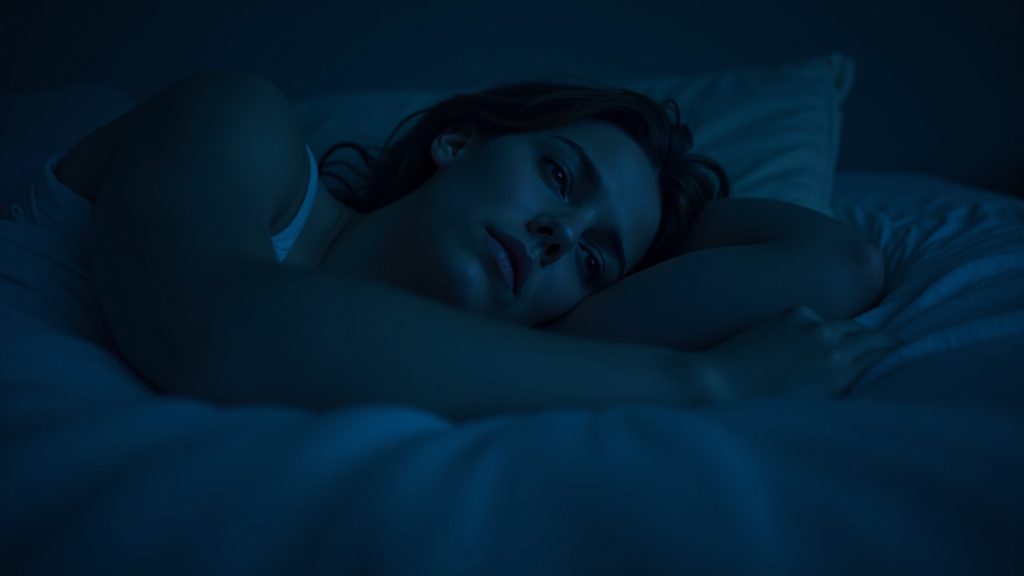
The Brain That Can’t Shut Down
When you lie down at night, two systems are supposed to cooperate. The first is the sleep-wake homeostat — the biological pressure to sleep that builds across the day. The second is the circadian system — your internal clock, governed by light exposure and melatonin. Together, they produce the smooth descent from alert wakefulness into sleep. But there is a third player that most sleep advice ignores: the default mode network (DMN). This is the brain network that activates when you are not focused on anything external — and for many people, it becomes a problem generator. It replays the day. It rehearses tomorrow. It loops through anxieties, counter-arguments, and to-do lists with a persistence that borders on obsessive. This is not a sleep disorder in the traditional sense. It’s an interference pattern — a normally-functioning cognitive system that fires at the wrong time, like a car alarm going off in an empty garage. Standard sleep hygiene advice doesn’t reach the DMN. Counting sheep doesn’t either. The DMN doesn’t respond to conscious commands. It responds to shifts in brainwave state.How Clinical Hypnosis Actually Works
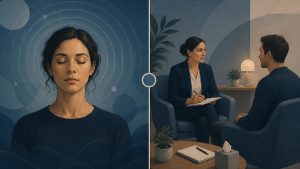
Clinical hypnosis isn’t what you have seen in stage shows. There’s no pocket watch. No one is going to make you cluck like a chicken. What happens during a properly-structured hypnotic induction is that the therapist guides you from alert beta-wave activity (13-30 Hz) into the alpha range (8-13 Hz) and then further into theta (4-8 Hz). Theta is the frequency your brain naturally produces as you drift toward sleep — but it’s also the frequency at which the DMN quiets down and the mind becomes suggestible in the therapeutic sense. This is not relaxation audio. It is not guided meditation. It is a structured sequence of language patterns — Ericksonian indirect suggestion, embedded commands, and naturalistic induction — that guides the brain through this transition without requiring effort or concentration from you. In effect, the hypnosis does the work your overactive brain refuses to do: it shifts the brainwave state first, and the sleep follows naturally.Binaural Beats and Isochronic Tones: The Audio Layer
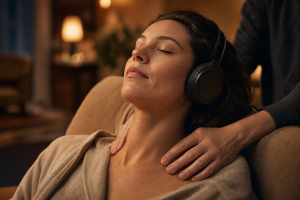
The best clinical hypnosis sessions don’t rely on language alone. They use an engineered audio layer underneath the hypnotic track that actively supports the brainwave shift. Binaural beats work by delivering two slightly different frequencies — one to each ear. The brain perceives the difference as a third tone and begins to synchronize its electrical activity to that frequency. This is called the frequency following response. Headphones are required for this effect. Isochronic tones take a different approach. Instead of relying on the brain to construct the beat internally, they pulse the tone directly into the audio at precise intervals. They are sharper, more defined, and more efficient at driving entrainment for many listeners. When combined with Ericksonian hypnotic language, these audio technologies create a layered entrainment environment — neurological tools that work in parallel with the suggestions, not as background music, but as an active part of the mechanism. A 2021 study in the Journal of Clinical Sleep Medicine found that participants who used theta-range binaural beats before bed fell asleep significantly faster than controls. A separate 2023 meta-analysis in Frontiers in Human Neuroscience confirmed that binaural beat stimulation in the theta range consistently reduced sleep onset latency across multiple studies.Why “Trying to Sleep” Makes It Worse
There is a cruel irony built into insomnia: the harder you try, the more elusive sleep becomes. This is called sleep effort syndrome, and it’s a well-documented phenomenon in sleep medicine. When you lie in bed actively trying to fall asleep, you generate performance anxiety. Your brain treats sleep as a task to be completed — which triggers the very alertness you’re trying to escape. The more you try, the more awake you feel. The more awake you feel, the more you try. It’s a closed loop. Hypnosis breaks this loop not by teaching you a technique, but by bypassing the trying altogether. You don’t have to do anything except listen. The induction handles the transition. Your only task is to let it.What the Research Says
The clinical evidence for hypnosis as a sleep intervention has been building steadily:- A 2018 randomized controlled trial published in Sleep found that participants who listened to a hypnosis audio before bed experienced 67% more slow-wave sleep (deep sleep) than controls.
- A 2020 study in the International Journal of Clinical and Experimental Hypnosis demonstrated that three weeks of nightly hypnosis listening significantly reduced sleep onset latency and improved subjective sleep quality in chronic insomnia patients.
- The American Psychological Association recognizes clinical hypnosis as a validated therapeutic modality, and sleep improvement is one of the most well-researched applications.
Start Tonight
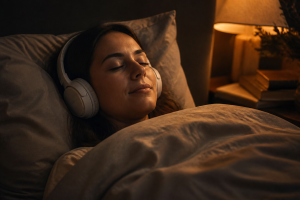
If you have been fighting with your own brain at 2am, you already know that more information isn’t the answer. You don’t need another article about sleep hygiene. You need a tool that works at the level of brainwave state — not at the level of willpower. That is exactly what was built for: 20 minutes of clinical hypnosis with binaural beats and isochronic tones, designed by a certified clinical hypnotherapist with over a decade of practice. No affirmations. No forcing calm. Just a threshold you cross without noticing. Headphones recommended. Press play, close your eyes, and let the session do the work.
~ 5 min read · More articles →